Welcome to Ane Publishers and Distributors__Use promo code 'ANE25' at checkout to get a 25% discount.


Advances in digital computing offer a very practical approach for system analysis and planning studies by resolving mathematical models of massive, integrated power systems. An undergraduate student should therefore become familiar with the most contemporary techniques for analyzing huge power systems. Similar abilities are needed in industry because power system engineers must always keep up with the industry's rapid innovations. This book's goal is to fulfil this demand by combining analytical techniques for systems of realistic sizes with the core ideas of power system analysis, which are demonstrated using the most basic system structure.
The book covers topics in power system operation and control that are covered in undergraduate and graduate course curricula. The reader is expected to have prior knowledge of circuit theory, electrical machines, control theory, and simple matrix operations. The book consists of six chapters.
Written in a student-friendly style, the book provides simple and understandable computational concepts and algorithms of engineering design so that readers can develop their own programs in any high-level programming language. This book is intended to meet the needs of a diverse range of groups interested in power system operation and control. It is designed to serve as a basic textbook for undergraduate and postgraduate students of electrical engineering and its allied disciplines of engineering, as well as a reference for faculty, researchers, and engineers interested in the operation and control of power systems.
J.S. Dhillon received his B.E. (Electrical) (1983) from Guru Nanak Dev Engineering College, Ludhiana, his M.E. (Systems) (1987), Punjab Agricultural University, Ludhiana, and his Ph.D. (1996) from Thapar Institute of Engineering & Technology, Patiala. His research activities include microprocessor applications, multi-objective thermal dispatch, hydrothermal scheduling, optimisation, neural networks, fuzzy theory, and soft computing applications in power systems. A fellow member of IE (India), a life member of ISTE and SSI, has supervised 28 Ph.D. and 36 M.E. scholars. He has contributed to these areas, as evidenced by the 210 research papers published in various national and international journals and proceedings. He has co-authored three books: "Digital Circuits & Design", Pearson Education; "Power System Optimisation", PHI Publication; and "Optimisation Algorithms for Engineers: Principles and Concepts”, Ane Books. Pvt. Ltd. He has worked at GZS College of Engineering & Technology, Bathinda, and Thapar Institute of Engineering & Technology, Patiala. Presently, he is a professor and former Dean (Academics).
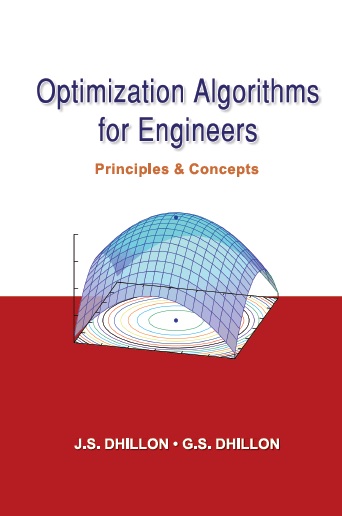
G.S. Dhillon received his B.E. in Computer Science and Engineering (2010) from Shaheed Udham Singh College of Engineering and Technology, Tangori, and his M. Eng., Electrical and Computer Engineering (2012) from the University of Windsor, Windsor, Ontario, Canada. His research activities include network security, wireless networking, neural networks, fuzzy theory, and soft computing. He gained experience working in the networking field and accomplished projects, such as the establishment of new networking systems at Samsung, Telus, IBM, TMX, TSX, and Canada Post. He has co-authored a book, “Optimization Algorithms for Engineers: Principles and Concepts". Ane Books Pvt. Limited. Presently, he is working on the computer that manages the flow of the logistics industry.
1 Fundamentals of Power System
2 Load Flow Studies
3 Power System Stability
4 Control of Frequency and Voltage
5 Monitoring and Control
6 Power System Economics and Management
Appendix, Bibliography, Index